

Biometric Vehicle Access Market to Reach US$ 5,142.8 Million by 2033, Growing at 17.3% CAGR (2026–2033)
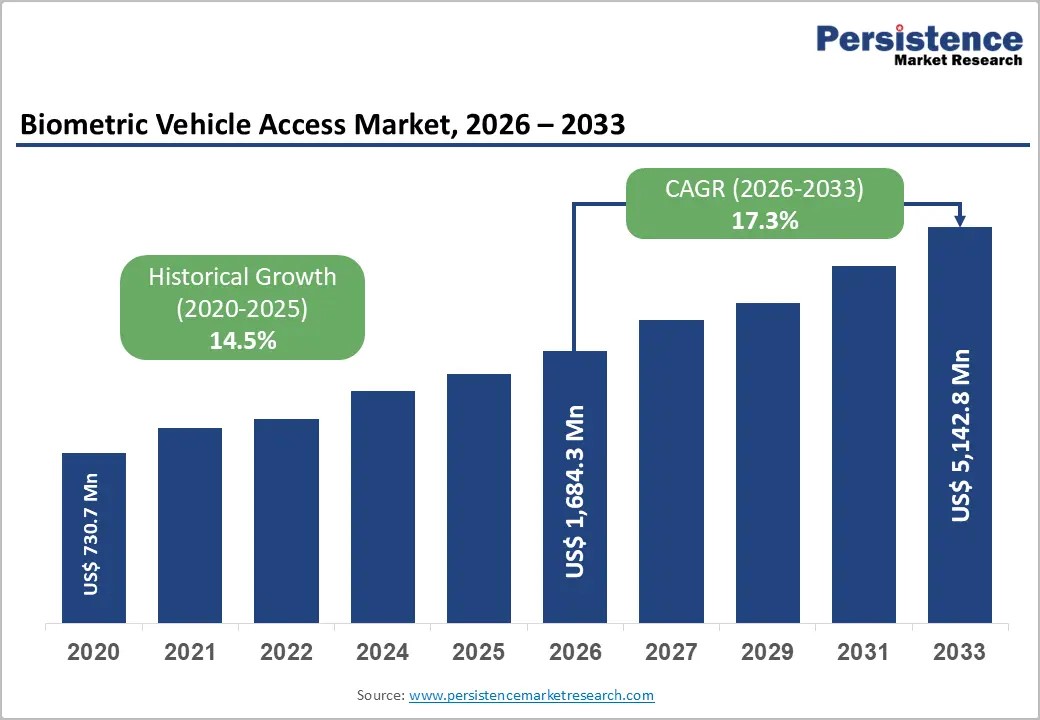
Biometric vehicle access market to reach US$5,142.8 Mn by 2033 from US$1,684.3 Mn in 2026, growing at a CAGR of 17.3% driven by smart vehicle security demand
BRENTFORD, ENGLAND, UNITED KINGDOM, June 30, 2026 /EINPresswire.com/ -- The global Biometric Vehicle Access Market is experiencing strong growth, driven by rising demand for advanced vehicle security, increasing adoption of connected and electric vehicles, and the shift toward intelligent, keyless authentication systems. Valued at US$ 1,684.3 million in 2026, the market is projected to reach US$ 5,142.8 million by 2033, expanding at a CAGR of 17.3% during the forecast period. Growth is further supported by advancements in AI, falling sensor costs, and the rise of software-defined vehicles enabling seamless biometric integration.
Fingerprint recognition leads the market with around 45% share, while hardware dominates the component segment with over 62% share due to widespread use of biometric sensors and modules. Electric vehicles are emerging as the fastest-growing segment, supported by their digital architecture and connectivity features. North America holds the largest market share at nearly 34%, driven by early adoption of connected vehicles and strong automotive innovation, whereas Asia Pacific is the fastest-growing region due to rapid EV expansion and increasing vehicle digitalization.
𝐆𝐞𝐭 𝐚 𝐒𝐚𝐦𝐩𝐥𝐞 𝐏𝐃𝐅 𝐁𝐫𝐨𝐜𝐡𝐮𝐫𝐞 𝐨𝐟 𝐭𝐡𝐞 𝐑𝐞𝐩𝐨𝐫𝐭: https://www.persistencemarketresearch.com/samples/36725
Market Segmentation
The Biometric Vehicle Access Market is segmented into hardware and software components. Hardware dominates the market due to the extensive use of biometric sensors such as fingerprint scanners, facial recognition cameras, iris scanners, and embedded authentication modules that ensure secure vehicle access. Software is the fastest-growing segment, driven by AI-based authentication, cloud integration, cybersecurity enhancements, and over-the-air updates that improve accuracy and personalization.
By vehicle type, the market includes passenger vehicles, commercial vehicles, and electric vehicles (EVs). Passenger vehicles hold the largest share as consumers demand better security and convenience features, while EVs are the fastest-growing segment due to their software-driven architecture and strong compatibility with advanced biometric systems.
Based on authentication type, fingerprint recognition leads the market owing to its reliability, low cost, and ease of integration. Facial recognition is growing rapidly due to its contactless operation and added capabilities like driver monitoring and fatigue detection.
In terms of sales channels, OEM dominates as most biometric systems are integrated during vehicle manufacturing for better performance and compliance. The aftermarket segment is expanding quickly as consumers adopt retrofit solutions to upgrade existing vehicles with advanced security features.
Regional Insights
North America leads the global market, supported by strong adoption of connected vehicles and advanced automotive technologies, with companies like Tesla, Ford, and General Motors driving integration. Europe also holds a significant share, driven by luxury automakers such as BMW, Mercedes-Benz, and Volkswagen Group, along with strict cybersecurity regulations that encourage secure biometric systems.
Asia Pacific is the fastest-growing region, led by China’s rapidly expanding EV sector and strong AI-driven automotive innovation, followed by rising adoption in India, Japan, and South Korea. Meanwhile, Latin America and the Middle East & Africa are gradually adopting biometric vehicle access systems, supported by growing vehicle digitization and improving automotive infrastructure.
𝐃𝐨 𝐘𝐨𝐮 𝐇𝐚𝐯𝐞 𝐀𝐧𝐲 𝐐𝐮𝐞𝐫𝐲 𝐎𝐫 𝐒𝐩𝐞𝐜𝐢𝐟𝐢𝐜 𝐑𝐞𝐪𝐮𝐢𝐫𝐞𝐦𝐞𝐧𝐭? 𝐑𝐞𝐪𝐮𝐞𝐬𝐭 𝐂𝐮𝐬𝐭𝐨𝐦𝐢𝐳𝐚𝐭𝐢𝐨𝐧 𝐨𝐟 𝐑𝐞𝐩𝐨𝐫𝐭: https://www.persistencemarketresearch.com/request-customization/36725
Market Drivers
The increasing incidence of global vehicle theft remains one of the strongest drivers of the Biometric Vehicle Access Market. Traditional key-based systems have become increasingly vulnerable to sophisticated hacking techniques and relay attacks, prompting automakers to adopt biometric authentication methods that offer significantly higher security. Fingerprint, facial, and iris recognition technologies ensure that only authorized individuals can access and operate vehicles, reducing theft risks while improving consumer confidence. Simultaneously, rapid adoption of electric vehicles and software-defined vehicles is accelerating integration of biometric technologies due to their advanced digital architecture. Falling sensor prices, AI-enabled authentication algorithms, and growing consumer demand for personalized driving experiences further strengthen market expansion.
Market Restraints
Despite promising growth prospects, the market faces several challenges that may restrict widespread adoption. Biometric vehicle access systems require advanced hardware, software integration, cybersecurity compliance, and extensive testing, resulting in relatively high implementation costs. These additional costs make deployment more practical in premium vehicles while limiting penetration across entry-level and mid-range models. Furthermore, privacy concerns surrounding biometric data collection remain a significant challenge. Regulations such as GDPR and other biometric privacy laws require strict handling of sensitive personal information, increasing compliance costs for manufacturers. Consumer concerns regarding data security and unauthorized access to biometric information may also slow adoption in certain regions.
Market Opportunities
The future of the Biometric Vehicle Access Market extends well beyond vehicle entry and ignition. Artificial intelligence combined with multi-modal biometric authentication is creating opportunities for fully personalized in-car experiences where vehicles automatically adjust seat position, climate settings, infotainment preferences, and driving modes based on individual user profiles. Connected vehicles also enable secure in-car payment authentication using fingerprint recognition, creating additional revenue opportunities for automotive manufacturers. Fleet management represents another rapidly expanding opportunity as logistics companies, ride-sharing operators, and corporate fleet owners increasingly deploy biometric authentication to improve driver accountability, reduce unauthorized vehicle usage, enhance operational efficiency, and strengthen insurance compliance.
Company Insights
Key Players
• Continental AG
• Robert Bosch GmbH
• Denso Corporation
• Valeo SA
• Hyundai Mobis
• Gentex Corporation
• Magna International Inc.
• ZF Friedrichshafen AG
• Synaptics Incorporated
• Fingerprint Cards AB
• Hitachi Ltd.
• NEC Corporation
• Thales Group
• HID Global
• Others
𝐁𝐮𝐲 𝐍𝐨𝐰 𝐭𝐡𝐞 𝐃𝐞𝐭𝐚𝐢𝐥𝐞𝐝 𝐑𝐞𝐩𝐨𝐫𝐭: https://www.persistencemarketresearch.com/checkout/36725
Conclusion
The global Biometric Vehicle Access Market is entering a transformative phase as vehicle manufacturers increasingly prioritize intelligent security, seamless user authentication, and connected mobility solutions. The combination of artificial intelligence, advanced biometric sensors, cloud connectivity, and software-defined vehicle architecture is fundamentally changing how drivers interact with their vehicles. While implementation costs and data privacy regulations remain notable challenges, continued technological innovation, expanding electric vehicle adoption, and growing consumer demand for personalized driving experiences are expected to sustain strong market growth. As biometric authentication evolves beyond vehicle access into personalized mobility services, fleet management, digital payments, and connected ecosystems, the market is poised to become a critical component of the next generation of smart and secure automotive technologies.
Related Reports:
Middleoffice BPO Services Market
Pooja Gawai
Persistence Market Research
+1 646-878-6329
email us here
Visit us on social media:
LinkedIn
Instagram
Facebook
YouTube
X
Legal Disclaimer:
EIN Presswire provides this news content "as is" without warranty of any kind. We do not accept any responsibility or liability for the accuracy, content, images, videos, licenses, completeness, legality, or reliability of the information contained in this article. If you have any complaints or copyright issues related to this article, kindly contact the author above.
